The 2026 market is placing greater pressure on buyers to choose durable, efficient, and traceable building products. Aluminium Door With Window systems are increasingly specified for homes, offices, hotels, and coastal developments. Their slim frames can create wider glass areas, while powder-coated surfaces provide practical protection against weathering. Yet appearance alone proves very little.
The International Aluminium Institute projects that global aluminium demand could rise by approximately 80% by 2050. This long-term outlook supports aluminium’s importance in modern construction and infrastructure. The International Energy Agency also identifies recycling and lower-carbon production as essential for reducing aluminium’s environmental impact. For global buyers, material origin now matters alongside price. Ask suppliers about alloy grades, recycled content, coating standards, and production records.
Performance must be tested, not assumed. A reliable Aluminium Door With Window should show documented results for air leakage, water resistance, wind pressure, thermal insulation, and hardware durability. Standards such as EN 14351-1 and relevant ASTM procedures can help buyers compare products across markets. However, certification does not automatically guarantee suitability for every climate. A door designed for a mild European region may perform differently in humid Southeast Asia or strong coastal winds.
This guide examines frame design, glazing choices, thermal breaks, safety features, customization, and supplier verification. It also considers shipping dimensions, installation tolerances, warranty language, and after-sales support. Reports provide useful direction, but they are not perfect. Real project evidence still matters. A carefully reviewed sample, tested before bulk ordering, may prevent expensive surprises.
2026 Aluminium Door-With-Window Basics: 6063-T5 Alloy and Key Parts
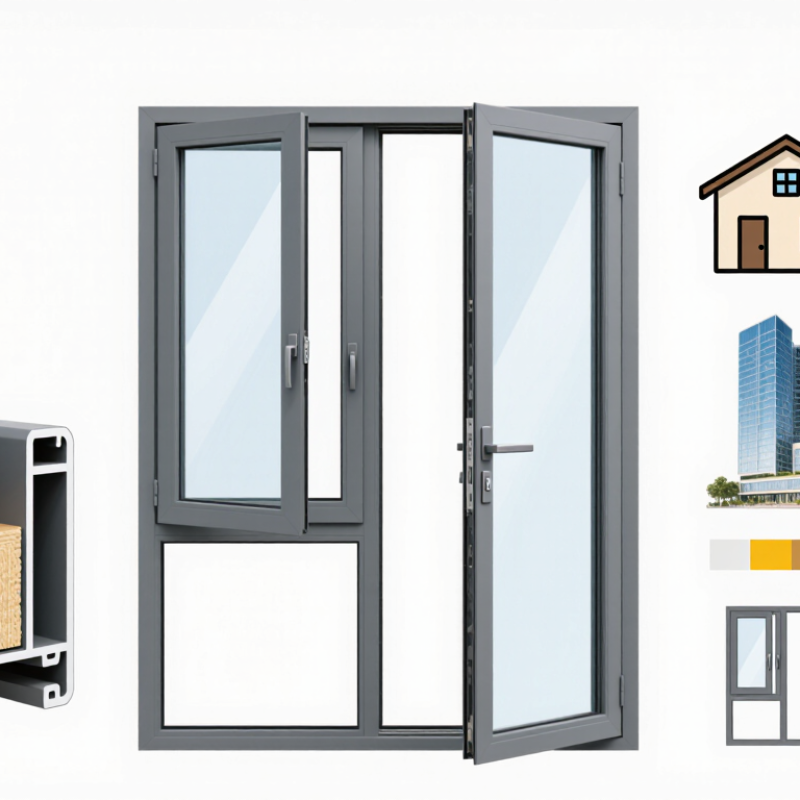
For global buyers, 6063-T5 aluminum offers a practical base for door-with-window systems. The alloy contains magnesium and silicon, supporting smooth extrusion and reliable corrosion resistance. T5 means the profiles were artificially aged after extrusion. This improves hardness and dimensional stability. It is not the strongest aluminum grade available. However, it suits many residential and light commercial applications. Coastal air still requires careful finishing and maintenance. Finish quality matters.
A dependable unit begins with a correctly designed frame. The frame supports the glass and transfers loads into the wall. The moving sash needs accurate alignment and strong corner connections. Double glazing can improve insulation and reduce outdoor noise. Seals around the glass and opening limit drafts and rain entry. Hinges and locks should match the door weight. Drainage paths must remain open. Small parts matter.
During site checks, I look for straight profiles, even gaps, and smooth hardware movement. I have seen attractive frames fail because water had nowhere to escape. That mistake is easy to overlook during factory inspection. Buyers should request alloy details, profile thickness, glass specifications, and hardware test records. Thermal breaks can reduce heat transfer, but poor installation can cancel their benefit. My own caution is simple: test samples before placing large orders.
2026 Best Aluminium Door With Window for Global Buyers - 2026 Aluminium Door-With-Window Basics: 6063-T5 Alloy and Key Parts
A practical reference table for comparing aluminium door-with-window systems. Actual performance depends on the complete tested assembly, glass specification, installation quality, climate and applicable local regulations.
| Data Dimension | Reference Specification or Typical Data | Why It Matters to Global Buyers | Verification Point |
|---|---|---|---|
| Primary frame alloy | 6063 aluminium alloy Commonly selected for architectural extrusions because it provides good surface finish, corrosion resistance and extrusion performance. |
Suitable for profiles with detailed shapes, thermal-break chambers and clean architectural finishes. | Request the alloy designation and material certificate for the extruded profiles. |
| Typical temper | 6063-T5 T5 indicates that the extrusion is cooled from an elevated-temperature shaping process and then artificially aged. |
Provides a practical balance of strength, dimensional stability and finish quality for many door and window profiles. | Confirm whether the profile is supplied as T5 or another temper, such as T6, because mechanical properties differ. |
| Reference mechanical properties | For 6063-T5 extruded product, commonly referenced minimum values are approximately 152 MPa tensile strength and 110 MPa yield strength; exact values depend on product form, wall thickness and governing standard. | Helps assess profile strength, hardware support and resistance to service loads. | Use the applicable standard and the supplier’s mill or inspection certificate rather than relying only on catalog values. |
| Aluminium density | Approximately 2.70 g/cm³ at room temperature. | Aluminium doors are generally lighter than comparable steel systems, which can reduce handling and hinge loads. | Check the finished door weight, including glass, hardware, seals and reinforcement. |
| Thermal expansion | Approximately 23.5 µm/m·K for aluminium near room temperature. | Long frames and large temperature changes require suitable expansion allowances and correct installation gaps. | Review frame-to-opening tolerances, fixing locations and perimeter sealing details. |
| Thermal-break design | Polyamide insulating strips separate the interior and exterior aluminium sections in a thermally broken frame. | Reduces conductive heat transfer and helps limit interior condensation in cooler conditions. | Ask for the thermal-break width, frame Uf value and complete door Uw value. Uw must be based on the full tested or calculated assembly. |
| Glass configuration | Single glazingDouble insulating glassLaminated glassTempered glass Double glazing commonly uses two panes separated by a sealed cavity; low-emissivity coatings and inert-gas fills may improve insulation. |
Glass often controls the door’s thermal, acoustic, safety and solar-performance results. | Confirm glass thickness, safety classification, cavity width, coating position, gas fill and spacer type. |
| Safety glass | Tempered glass is designed to break into smaller granules after failure; laminated glass retains fragments with an interlayer. | Important for doors, low-level glazing, impact-prone areas and locations requiring fall-through or security protection. | Match the glass type to local building codes and the project’s impact, safety and security requirements. |
| Weather seals | EPDM or comparable durable elastomeric gaskets are commonly used for glazing and perimeter sealing. | Continuous, correctly compressed seals help control air leakage, water penetration and noise transmission. | Check gasket compatibility, corner joints, drainage paths and replaceability. |
| Drainage system | Rebated frames normally use internal drainage channels and weep holes to discharge water to the exterior. | Effective drainage reduces the risk of water accumulation inside the frame and around the opening. | Ensure drainage holes remain unobstructed after installation and are positioned for the intended sill condition. |
| Operating hardware | Typical parts include hinges, handles, cylinders, locking rods, keep plates, rollers where applicable and restrictors. | Hardware affects security, operating force, durability, serviceability and compatibility with the door weight. | Confirm corrosion resistance, adjustment range, load rating, replacement availability and compatible cylinder dimensions. |
| Locking arrangement | Single-point or multipoint locking may be used. Multipoint systems engage several points along the meeting stile. | Multiple engagement points can improve compression of seals and resistance to forced opening when correctly installed. | Specify the number and position of locking points, cylinder type, emergency function and key-operated or handle-operated operation. |
| Surface finishes | AnodizingPowder coatingLiquid coating Anodizing forms an integral oxide layer; powder coating creates a separate cured coating layer. |
Finish selection affects appearance, UV resistance, scratch resistance and maintenance requirements. | Specify color reference, gloss level, coating thickness, pretreatment and applicable durability requirements. |
| Common finish references | Architectural projects may reference ISO 7599 for anodizing or AAMA 2603, 2604 or 2605 for organic coatings, depending on the market and project specification. | Recognized specifications make finish quality easier to compare across suppliers and regions. | Verify the exact test scope, warranty conditions and suitability for coastal, industrial or high-UV environments. |
| Air, water and wind performance | Performance is tested on the complete door assembly, not on the aluminium alloy alone. Common references include ASTM E283 for air leakage, ASTM E331 for water penetration and ASTM E330/E330M for structural performance. | Provides a meaningful basis for comparing resistance to drafts, rain and wind pressure. | Request laboratory test reports showing specimen size, pressure levels, test method and pass/fail results. |
| European test references | Common references include EN 1026 for air permeability, EN 1027 for watertightness and EN 12211 for resistance to wind load. | Useful when the project follows European or related international specifications. | Check the declared classification under the relevant product standard and national requirements. |
| Security considerations | Security depends on the complete door, including glass, frame, lock, hinges, cylinder, fasteners and installation. Security classifications may be specified under standards such as EN 1627. | A strong aluminium profile alone does not establish the security level of the finished door. | Request a complete-system security test report and confirm the tested hardware and glass configuration. |
| Acoustic performance | Sound reduction is influenced by glass thickness, laminated interlayers, cavity construction, seals and installation. Results are normally expressed as Rw or a local equivalent. | Helps buyers select a suitable system for urban, roadside, hospitality or office environments. | Compare complete-door laboratory results at the required size; do not use glass-only data as the door rating. |
| Installation essentials | Use a plumb, level and square opening; provide compatible packers and anchors; maintain drainage; seal the perimeter with materials compatible with aluminium, glass and masonry. | Incorrect installation can reduce air, water, thermal and security performance even when the product is well designed. | Require installation drawings, fixing spacing, tolerances, sill details and maintenance instructions. |
| Buyer documentation checklist | Technical drawing, profile section, alloy and temper declaration, glass specification, hardware schedule, finish specification, test reports, installation guide and maintenance instructions. | Complete documentation supports customs review, project approval, quality inspection and future replacement of components. | Ensure documents identify the exact configuration, dimensions and tested assembly rather than a generic product family. |
FAQS
6063-T5 aluminum suits many residential and light commercial door-with-window systems. Magnesium and silicon support smooth extrusion and corrosion resistance. It is not the strongest aluminum grade. Coastal air still demands careful finishing and maintenance.
The frame supports the glass and transfers loads into the wall. The sash needs accurate alignment and strong corner connections. Hinges and locks must match the door weight. Small parts matter.
Double glazing can improve insulation and reduce outdoor noise. Seals help limit drafts and rain entry. Thermal breaks can reduce heat transfer. Poor installation may cancel these benefits.
Air ratings indicate leakage through seals and joints under pressure. Water ratings show resistance to pressured rain. Wind ratings relate to deflection and structural safety. Request complete test reports, not only rating labels.
Check the standard version, specimen size, glass type, and installation method. Confirm drainage, corner joints, and glazing seals. Rating names can differ between markets. Direct comparisons may mislead.
Inspect straight profiles, even gaps, and smooth hardware movement. Request alloy details, profile thickness, glass specifications, and hardware records. Test samples first. Attractive frames can still hide drainage problems.
Measure width, height, wall thickness, and diagonal accuracy at three points. Record the actual opening size, not only the old frame size. Confirm handing, sill height, frame depth, and screen needs. Small errors create large gaps.
Review coverage for profiles, coatings, glass seals, locks, rollers, and installation labor. Check exclusions, response times, and replacement procedures. Include freight, insurance, duties, unloading, and installation. The lowest quote may omit important costs.
The threshold must match the finished floor level and drainage plan. A mismatch can cause water entry or difficult installation. Recheck the threshold. I have overlooked this detail before.
Conclusion
This guide to the 2026 Aluminium Door With Window explains the essential features global buyers should evaluate before making a purchase. It covers 6063-T5 aluminium alloy, frame construction, thermal breaks, seals, glazing, handles, locks, hinges, and other key components. Thermal performance is compared through Uw values ranging from 0.8 to 1.6 W/m²K, helping buyers understand how frame and glass design can influence insulation, comfort, and energy use.
The article also introduces air tightness, water resistance, and wind-load performance classes for different climate conditions. It discusses double glazing, suitable glass configurations, and RC2-level security as useful benchmarks rather than universal requirements. A practical specification checklist highlights opening sizes, installation details, regional standards, finish requirements, warranty terms, maintenance expectations, delivery conditions, and total ownership cost. With these factors clearly defined, buyers can compare products more accurately and select an aluminium door-with-window solution that balances durability, performance, safety, and long-term value.